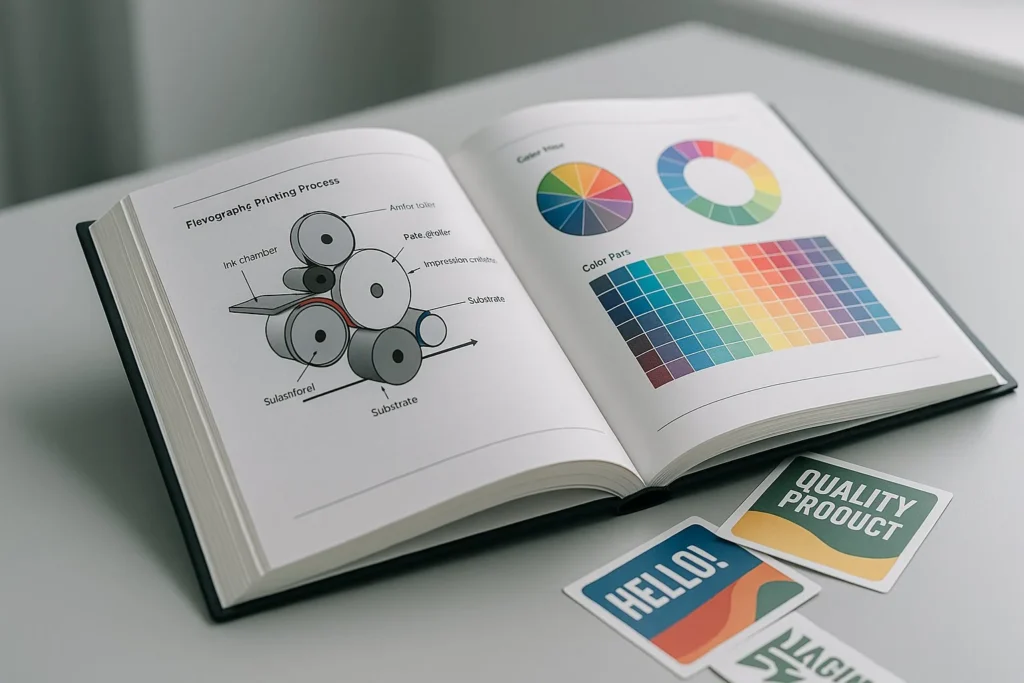
The Glossary of Printing is an indispensable tool for professionals in the printing and packaging industry. Understanding professional terminology is critical for successful cooperation between customers and manufacturers. With over 16 years of experience in flexographic printing, Sun Flex has prepared a comprehensive glossary of terms for your work.
Modern printing encompasses a wide range of technologies, from classic offset printing to innovative HD flexo printing. Each technology has its own specific terminology, which is important to understand for effective communication and making the right technical decisions.
Benefits of using a professional glossary
Accurate communication
Avoiding misunderstandings between the customer and the contractor by using standardized terminology in the printing industry.
Professional development
Expanding knowledge in the printing and packaging industry to improve skills and improve work quality.
Time saving
Quickly find the necessary definitions and explanations of technical processes without the need to search in different sources.
Standardization of processes
Compliance with international standards and requirements of the printing industry when implementing projects of varying complexity.
Main sections of the printing glossary
Flexographic printing
Flexographic printing is a letterpress printing method using flexible printing plates and liquid inks. It is ideal for printing on labels and flexible packaging.
Anilox is a ceramic or metal cylinder with microscopic cells for dispensing ink. The uniformity of ink application and print quality depend on the quality of the anilox.
A cliche is a printing plate for flexo printing, made of photopolymer. It is used to transfer an image onto the printed material.
Materials processing technologies
Lamination is the process of joining two or more layers of material using adhesive, pressure, or temperature. It is used in the production of laminated films.
Die cutting is the process of cutting finished products from printed material using pocket knives. It is necessary for the production of labels of complex shapes.
Embossing is the process of applying a relief image to a material under pressure. There are hot and cold embossing.
Technical terms of color separation
Materials and substrates
Substrate - the main material on which the print is applied. It can be paper, film, foil or other material.
BOPP - Biaxially Oriented Polypropylene Film. A popular material for making BOPP labels due to its excellent printing properties.
PE - polyethylene, a thermoplastic polymer widely used in packaging.
PET - polyethylene terephthalate, a strong and transparent material for labels and packaging.
The correct choice of substrate has a critical impact on the print quality and functional properties of the finished product. When choosing a material, it is necessary to consider the operating conditions, type of print and appearance requirements.
Print quality control
Densitometry is a method of measuring the optical density of ink to control print quality.
Colorimetry is the science of measuring color to ensure accurate reproduction of hues.
Delta E is the numerical value of the difference between two colors as perceived by the human eye.
Stages of working with technical documentation
1
Analysis of the technical task
Detailed study of customer requirements and technical characteristics of future products using professional terminology.
2
Preparing the layout
Creation of a printing layout taking into account the technical requirements for layouts and the specifics of the selected printing technology.
3
Prepress preparation
Layout processing, color separation, screening and preparation of printing plates in accordance with quality standards.
4
Quality control
Checking the compliance of finished products with technical requirements and quality standards using professional equipment.
Specialized packaging terms
A doypack is a type of flexible packaging with a flat bottom that allows the package to stand on its own. Learn more about doypacks and their benefits.
Shrink sleeve - a heat-shrinkable label that tightly fits the contour of the package after heat treatment.
Flow pack is a type of packaging with a longitudinal seam, widely used in the food industry.
A blister is a transparent molded package, commonly used in pharmaceuticals for tablets and capsules.
Frequently asked questions about printing terms
- What is the difference between flexo printing and offset printing?Flexo printing uses flexible plates and liquid inks, making it ideal for printing on flexible materials. Offset printing uses rigid plates and paste inks, making it better suited for paper.
- What is trapping and why is it needed?Trapping is a technique of overlapping adjacent colors to compensate for possible misregistration during printing. It prevents white spaces between colors.
- What is the difference between CMYK and Pantone?CMYK is a four-color printing model of basic colors, Pantone is a system of standardized spot colors for the accurate reproduction of specific shades.
- What does raster linework mean?The raster line count is the number of raster lines per inch (lpi), which determines the detail and quality of halftone reproduction in a print. The higher the line count, the more detailed the image.
- Why is densitometry needed?Densitometry is used to control the optical density of ink, which ensures color stability and print quality throughout the entire print run.
- What are the advantages of BOPP film?BOPP film has excellent transparency, high strength, resistance to moisture and chemicals, making it ideal for labels and packaging.
- What is an anilox and what is its role?Anilox is a special cylinder with microscopic cells that ensures precise dosing and uniform application of ink to the printing plate in flexographic printing.
Professional knowledge of printing terminology is the basis for successful work in the printing and packaging industry. Regularly updating your vocabulary and learning new technologies helps professionals remain competitive in the market.
Sun Flex is constantly updating its glossary in line with technological developments and the emergence of new industry standards. Our experts are always ready to provide advice on technical aspects of production and help with choosing the optimal solutions for your project.
Need expert advice?
Our experts with 25 years of experience will help you understand the technical nuances and choose the optimal solution for your project. Contact us for professional advice.